Transformers keep electrical grids running, but not every transformer does the same job. You might spot huge transformers at power plants and much smaller ones up on utility poles in your neighborhood.
These two types? They’re designed for totally different tasks in the power system.
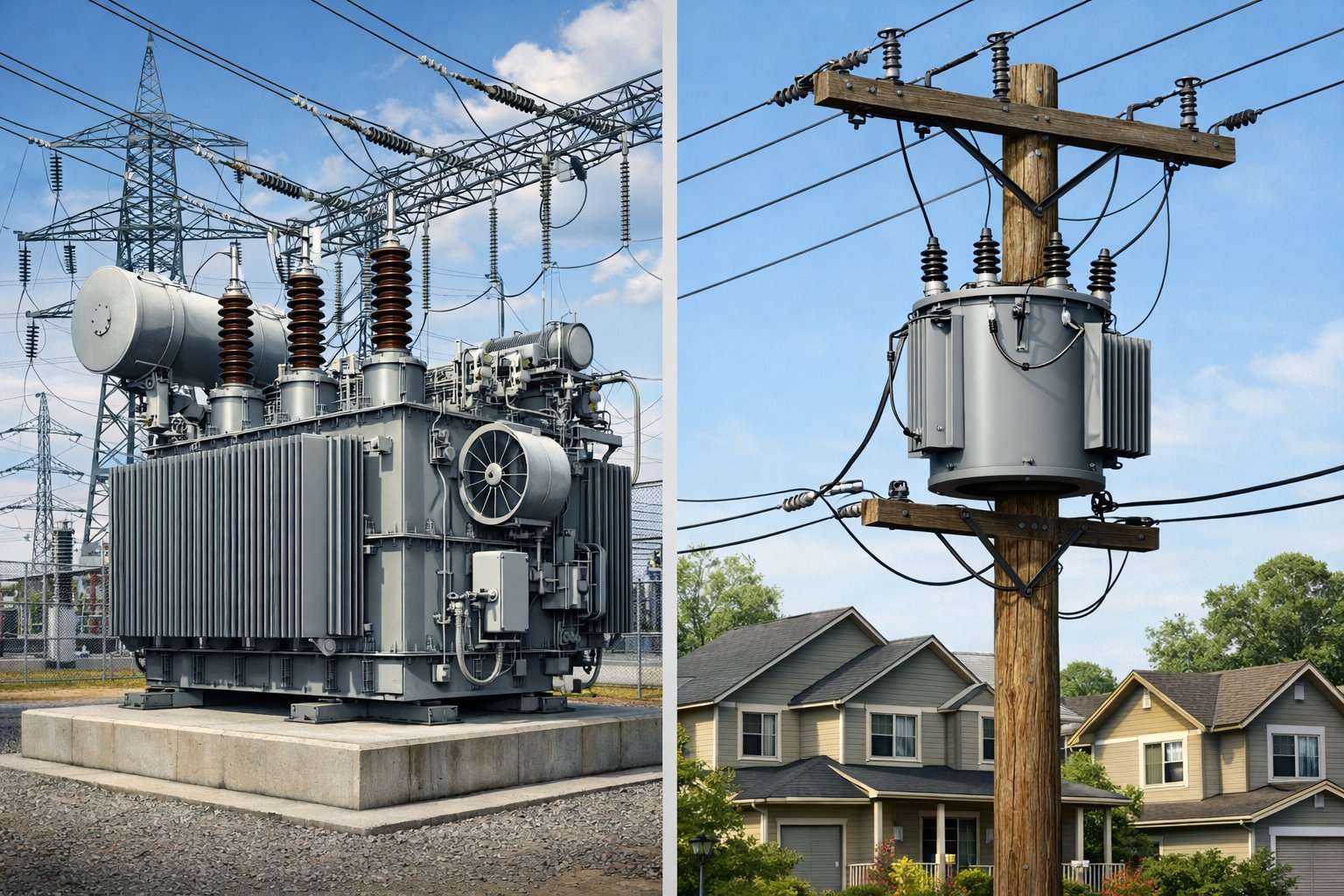
Power transformers handle bulk electricity at very high voltages in transmission networks, while distribution transformers reduce voltage to safe levels for homes and businesses. Power transformers work at voltages of 66 kV and above, moving massive amounts of electricity across long distances.
Distribution transformers operate at lower voltages, usually below 33 kV, and deliver power straight to your building.
The differences aren’t just about voltage. These transformers are built with different efficiency targets, power ratings, and cooling approaches.
If you want to really understand how electricity gets from a power plant to your wall outlet, it helps to know what sets these transformer types apart.
Key Takeaways
- Power transformers move bulk electricity at high voltages through transmission networks while distribution transformers step down voltage for consumer use
- Power transformers run near full load continuously and focus on reducing copper losses, but distribution transformers operate at varying loads and minimize iron losses
- Power transformers are rated in MVA for high-capacity applications while distribution transformers use kVA ratings for smaller local power delivery
Fundamental Comparison: Power Transformers vs Distribution Transformers
Power transformers handle bulk energy transfer at high voltages in transmission networks. Distribution transformers deliver final-stage voltage reduction to consumers at lower power levels.
Core Functions and Roles in Electrical Systems
Power transformers act as the backbone of high-voltage transmission systems. You’ll find them running at 66 kV and above, with power ratings measured in mega volt-amperes (MVA).
They either step up voltage at generation stations for long-distance transmission or step down extra-high voltages at major substations.
Distribution transformers take on a different job in the grid. They operate below 33 kV and are rated in kilo volt-amperes (kVA).
These units take medium-voltage power from distribution networks and knock it down to usable levels like 240V or 480V for homes and businesses.
Key operational differences:
- Power transformers: Run continuously near full load capacity, with efficiency optimized at 100% load
- Distribution transformers: Experience fluctuating loads throughout the day, with efficiency designed for 50-70% average load
- Loss priorities: Power transformers focus on minimizing copper losses, while distribution transformers prioritize reducing iron losses since they stay energized 24/7 regardless of load
Positioning in the Power Delivery Chain
Power transformers sit in two crucial spots in your transmission system. The first steps up voltage at the generation station, maybe from 25 kV to 132 kV, 220 kV, 400 kV, or higher.
The second steps down transmission voltage to primary distribution levels like 33 kV or 11 kV at receiving substations.
Distribution transformers finish the job. You’ll see them on utility poles, on concrete pads in neighborhoods, or tucked away in building basements.
They connect directly to the distribution network on one side and feed end-users on the other. Because of this, they have to handle loads that swing up and down as people use electricity throughout the day.
Power transformers stay centralized at big facilities. Distribution transformers spread out all over populated areas to meet local demand.
Key Technical Differences Between Power and Distribution Transformers
Power transformers and distribution transformers aren’t just different in size—they vary in voltage ratings, load handling, construction, and cooling needs. Each detail fits their role in the grid.
Voltage Levels and Power Ratings
Power transformers run at high and extra-high voltages, usually 66 kV and up on at least one winding. You’ll see them at 132 kV, 220 kV, 400 kV, or even 765 kV in major networks.
Their power ratings are in MVA (Mega Volt-Amperes), often from 100 MVA to more than 1000 MVA for the big guys.
Distribution transformers work at much lower voltages. Their primary side stays below 33 kV, and the secondary delivers consumer voltages like 415V/240V or 480V/277V.
They use kVA (Kilo Volt-Amperes) ratings, with common sizes from 15 kVA for small pole-mounts to 2500 kVA for big commercial setups.
Voltage level affects the insulation needed. Power transformers need heavy-duty insulation to handle the stress. Distribution transformers get by with less.
Load Operation and Efficiency
Power transformers run almost all the time at or near full load. That’s 80-100% of their rated power, day in and day out.
They hit maximum efficiency at or near full load—around 98-99.5% if you’re curious. Copper losses (which depend on load) dominate since these units always carry heavy current.
Distribution transformers see loads that swing around a lot. Sometimes they run at just 30-50% of their rating for hours.
Their maximum efficiency is tuned for lighter loads, usually at 50-70% of rated capacity. Because they stay energized all the time, iron losses (or core losses) matter most.
The B-H curve for the core gets optimized differently. Distribution transformer cores use lower flux density to cut core losses during long periods of light loading.
Power transformer cores can run at higher flux density because copper losses are the main concern during heavy, constant operation.
Size, Design, and Cooling Systems
Transformer size changes everything. Power transformers are enormous—hundreds of tons, sometimes needing special trucks just to move them.
Distribution transformers? They’re compact enough to hang from a pole or sit on a small pad.
Power transformers need complex cooling systems to shed heat from all that power. You might see:
- OFAF (Oil Forced Air Forced): Pumps move oil through radiators with forced air
- OFWF (Oil Forced Water Forced): Uses water-cooled heat exchangers
- ONAF (Oil Natural Air Forced): Oil circulates naturally, but fans push air through radiators
Distribution transformers usually stick with ONAN (Oil Natural Air Natural) cooling. That’s just oil moving and air flowing naturally, no pumps or fans needed.
Some bigger units might get radiators for a little extra cooling, but nothing too fancy.
Winding Configuration and Insulation Levels
Power transformers often use Delta-Delta or Star-Delta winding configurations, depending on what they’re doing.
Step-up transformers at generation plants usually go with Delta-Star. Step-down transformers at substations might use Star-Delta or Star-Star. Many of these transformers include on-load tap changers to tweak voltage under different loads.
Distribution transformers mostly use Delta-Star (or Delta-Wye). The star side gives you a neutral point for three-phase, four-wire systems that serve single-phase loads.
Insulation needs are very different. Power transformers require multiple layers of top-grade insulation, special bushings, and careful voltage grading. Distribution transformers use simpler insulation since they don’t see the same voltage stress.
Grid Placement and Applications
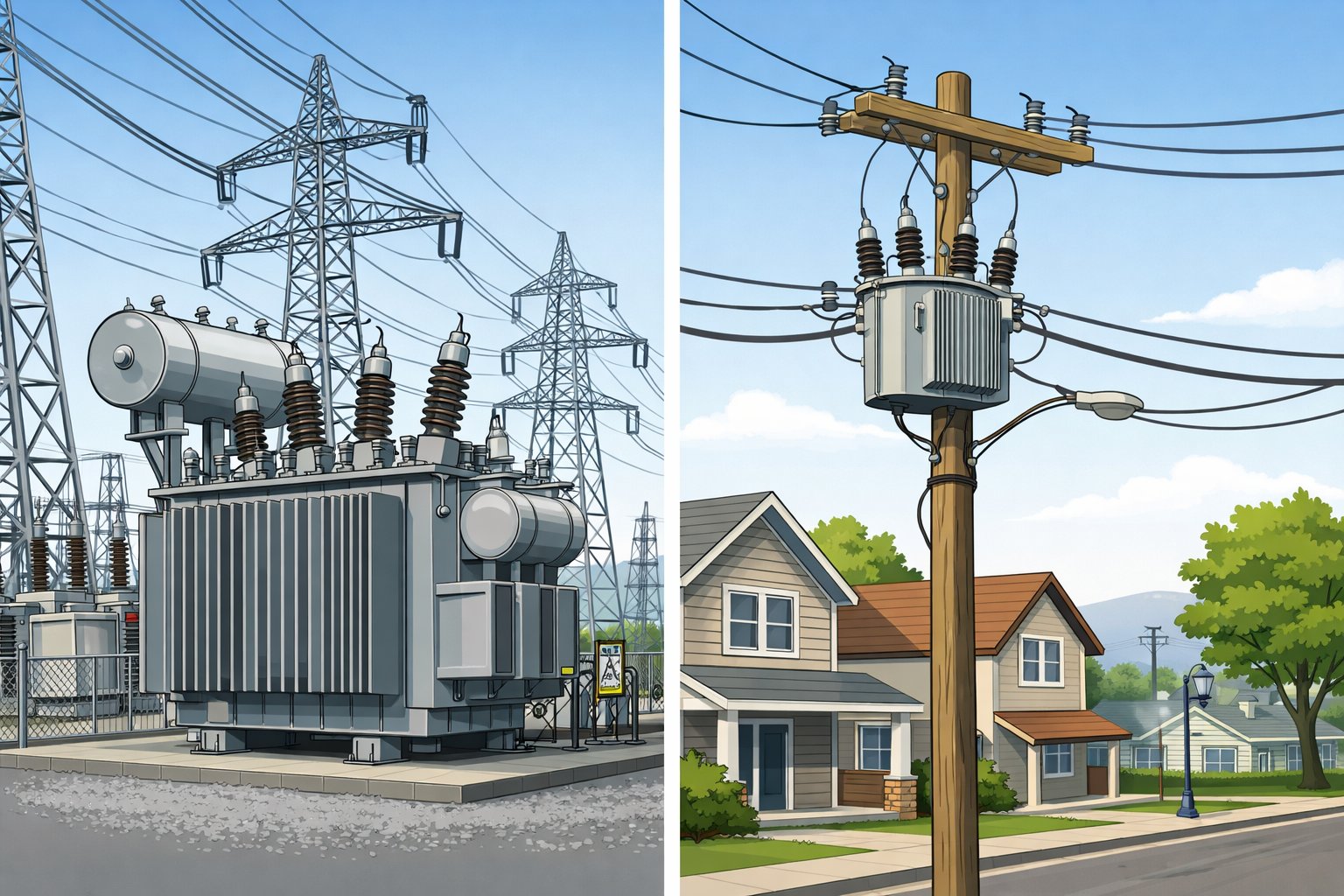
Power transformers move bulk energy at generation stations and transmission substations, operating at 66 kV and above. Distribution transformers step voltage down for end users and show up all over neighborhoods—on poles, pads, or in underground vaults.
Locations in the Transmission and Distribution Network
Power transformers fill two main spots in the grid. At the power plant, they step up voltage from 11-25 kV to transmission levels like 132 kV, 220 kV, or even 400 kV and above.
At transmission substations, they step down the voltage to primary distribution levels.
Distribution transformers work much closer to where you actually use electricity. You’ll find them at distribution substations, where they drop voltage one last time for delivery to consumers.
They’re the last voltage conversion point between the grid and your home or business. Sometimes, big industrial facilities use both types—power transformers for high-voltage feeds, and distribution transformers for their internal networks.
Installation Types and Typical Use Cases
Power transformers need permanent installations at substations. They sit on concrete, have big cooling systems, and lots of safety gear.
Don’t expect to see one in your neighborhood.
Distribution transformers come in three main installation types. Pole-mounted units hang on utility poles and serve overhead networks in residential and rural areas.
Pad-mounted transformers sit on the ground for underground systems in subdivisions and commercial zones. Underground vault transformers hide below street level in dense cities where space is tight.
Each setup fits a specific need. Pole-mounted units typically serve 5-25 homes and have ratings of 25-167 kVA. Pad-mounted transformers handle 75-2500 kVA for subdivisions, shopping centers, or offices.
Operational Performance and Losses
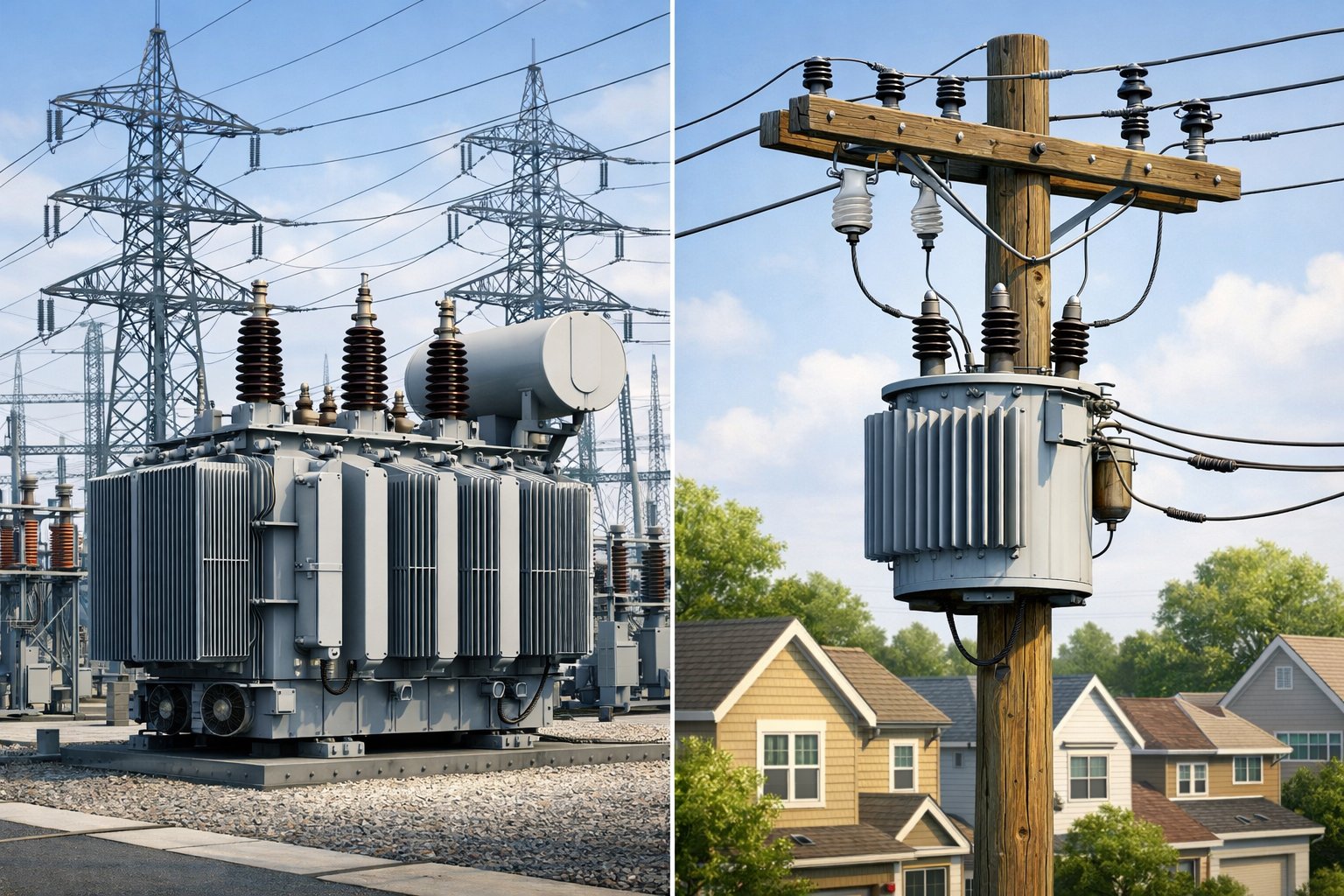
Power transformers and distribution transformers handle losses and efficiency very differently. Power transformers focus on high efficiency at near-full loads in transmission systems.
Distribution transformers need to perform well across changing load conditions, just like you’d expect in local power delivery networks.
Load Efficiency and All Day Efficiency
Load efficiency shows how well your transformer turns input power into output power at a certain load. Power transformers usually hit their best efficiency between 80-90% of rated load. Sometimes, they even reach 99.5-99.8% when running close to full capacity.
Distribution transformers hit their sweet spot at 50-70% of rated load. You’ll often see efficiency numbers between 98-99% for these units.
All day efficiency really matters for distribution transformers since their loads change all the time. This metric looks at both no-load and load losses over real operating conditions, not just the best-case scenario.
Your distribution transformer might run at 30% load late at night and then jump to 80% during a busy afternoon.
Power transformers, on the other hand, usually deal with steadier loads in transmission networks. Their design aims for top efficiency when they’re running at full load.
No-Load, Load, and Energy Losses
No-load losses happen all the time when your transformer is energized, even if there’s no load. These losses come from hysteresis and eddy currents in the core. Distribution transformers feel these losses more, percentage-wise, since they’re always on and dealing with changing loads.
Load losses—or copper losses—go up with the square of the current in the windings. Power transformers see higher load losses at full tilt because of the bigger currents they push. You can figure out load losses with I²R, where I is current and R is winding resistance.
Energy losses add up both types across the transformer’s working life. Say you’ve got a 1000 kVA transformer with 1% total losses; that’s about 87,600 kWh wasted every year if it runs nonstop. Power transformers keep energy losses low by running at steady, high loads. Distribution transformers try to reduce total losses by optimizing for changing load conditions.
Voltage Regulation and Load Fluctuations
Voltage regulation tells you how well your transformer keeps its output voltage steady when the load shifts. Distribution transformers need tighter voltage regulation since their loads bounce around a lot during the day. If regulation is poor, you’ll see voltage drops at peak times and spikes when things get quiet.
Power transformers usually deal with more stable loads in transmission systems. Their load swings aren’t as wild. Your distribution transformer might go from 20% to 90% load in a few hours, while a power transformer tends to stick between 70-100% of rated capacity.
Load swings hit transformer losses and efficiency in different ways depending on the type. Distribution transformers use tap changers to tweak voltage ratios and keep things stable as loads change. Power transformers lean on steady frequency and load patterns to hold their high efficiency. Picking the right transformer really comes down to matching it with your expected load swings.
Special Features and Protection Considerations
Power transformers need higher insulation and more advanced cooling to handle transmission voltages above 33 kV. Distribution transformers get by with simpler protection, since they’re on lower voltage networks. Safety features differ a lot depending on where and how you use the transformer.
Cooling and Insulation Methods
Power transformers use oil-natural air-natural (ONAN) or oil-natural air-forced (ONAF) cooling systems. They have to, since they run at high voltages and carry heavy loads pretty much all the time. These cooling setups circulate oil through radiators to pull heat away from the windings.
The insulation in power transformers has to stand up to voltages from 33 kV to 400 kV, so you’ll see thick barriers and top-grade transformer oil. Distribution transformers usually stick with simpler cooling like ONAN for pole-mounted units, or dry-type insulation for indoor setups.
These units have lower insulation needs since they’re below 33 kV. Pad-mounted distribution transformers use sealed tanks with natural oil flow, which keeps maintenance low for neighborhoods and businesses.
Tap Changers and Transformer Protection
Power transformers often come with on-load tap changers that let you adjust voltage ratios while the transformer’s running. These tap changers keep voltage steady across long lines by tweaking the turns ratio between windings. Specialized control systems keep these tap changers working safely when you need to regulate voltage.
Distribution transformers usually have off-circuit tap changers, or sometimes none at all. If you do need to adjust taps, you have to de-energize the transformer first. Circuit breakers and fuses handle most of the protection for distribution units. They’re set up to disconnect the transformer quickly if there’s an overload or a fault.
Safety Features and Grid Interconnection
Your power transformer setup needs several protection layers—differential relays, overcurrent protection, and Buchholz relays that spot internal faults by detecting gas in the oil. These transformers connect straight to the transmission grid at generation stations and substations. They’re the backbone of the energy network.
Distribution transformers use simpler protection like fuse cutouts, lightning arresters, and basic overcurrent devices. You usually mount these closer to where people actually use electricity, so safety features like tamper-resistant cases and low-profile ground pads really matter. Grid interconnection standards for these units focus more on keeping service reliable for homes and businesses instead of moving bulk power.
Summary of Differences and Selection Criteria
Power transformers handle high-voltage transmission at 66kV and above, usually rated in MVA. Distribution transformers step down voltage below 33kV and are rated in kVA to supply power straight to users. The right pick depends on where your transformer fits in the system and what kind of loads it’ll face.
How to Choose Between Power and Distribution Transformers
You need to match transformer types to their role in the electrical system. Go for a power transformer if you’re working with high-voltage transmission—66kV, 132kV, 400kV, or above—for long-distance lines. These run at full load most of the time and are rated in MVA.
Pick a distribution transformer if you need to step down voltage for end users. You’ll usually start at 33kV or 11kV and drop down to 120V or 110V for homes. These are rated in kVA and see loads that change all day long.
Think about efficiency based on your load patterns. Power transformers hit their best efficiency at full load because they’re always working hard. Distribution transformers do best at 50-70% load since they’re always on but usually aren’t running flat out.
Role in Modern Electrical Systems
Power transformers form the backbone of transmission. They step up voltage at generation plants and step it down again at major substations. You’ll see them moving big blocks of power between parts of the grid, making long-distance delivery possible with minimal losses.
Distribution transformers close the loop in your power system. You’ll spot them on poles, pads, or inside vaults, serving neighborhoods, businesses, and factories. They make high-voltage power usable for your gear and appliances.
Both types work in a chain. Power flows from generators through step-up power transformers, travels down transmission lines, drops through step-down transformers at substations, and finally passes through distribution transformers to reach you at safe voltages.
Frequently Asked Questions
Power transformers work in transmission networks above 66 kV and move bulk power, while distribution transformers operate below 33 kV to deliver electricity to your home or business. The two types are built differently: power transformers focus on full-load efficiency, and distribution transformers are better for lighter, shifting loads.
What are the primary distinctions in function between power transformers and distribution transformers?
Power transformers move bulk power in transmission networks. They step up voltage at power plants and step it down at substations for distribution.
Distribution transformers handle the last voltage drop in the delivery chain. They take medium voltage from distribution lines and bring it down to levels you can actually use. You’ll find these on utility poles, concrete pads, or tucked into building basements.
How do the voltage levels at which power transformers and distribution transformers operate compare?
Power transformers run at high and extra-high voltages—66 kV and up. You’ll see them handling 132 kV, 220 kV, 400 kV, or even 765 kV on transmission lines.
Distribution transformers work at lower voltages, usually below 33 kV on the primary side. On the secondary side, they give you standard voltages like 415V/240V for homes or 480V/277V for businesses. This keeps electricity safe and usable for everyone.
What are the differences in physical size and installation requirements between power transformers and distribution transformers?
Power transformers are big and heavy because of their high MVA ratings. You’ll need strong concrete foundations and dedicated transformer yards at substations. Their cooling systems can get pretty complicated—think oil-forced air-forced or oil-forced water-forced setups.
Distribution transformers are much smaller and lighter, with ratings in kVA. You can put them on utility poles, small pads, or even in underground vaults. Most use simple natural oil and air cooling, so they’re easier to install and don’t take up much space.
Can you explain the differences in efficiency and load capabilities between power and distribution transformers?
Power transformers are built to run at or near full load all the time. Their efficiency peaks at 100% load, since copper losses are the main concern when they’re working hard. These units can handle hundreds of MVA.
Distribution transformers see loads that swing up and down all day. They stay on 24/7 but often run at 50% capacity or less. Their design aims for top efficiency at 50-70% load, so they can keep iron losses down when things are quiet. Most are rated from 15 kVA up to a few thousand kVA.
In what ways do power transformers and distribution transformers differ in terms of their maintenance needs?
Power transformers need more regular and detailed maintenance because of their complex cooling and the heavy loads they carry. You’ll have to check oil, inspect cooling systems, and keep an eye on advanced protection gear. Maintenance schedules are tight since a failure can knock out big parts of the grid.
Distribution transformers are simpler and need less frequent care. You should still check the oil and look them over now and then, but the process is easier. Their smaller size and lighter workload mean the maintenance burden is lighter than with power transformers.
How do the roles of power transformers and distribution transformers vary in an electrical power distribution system?
Power transformers really form the backbone of the transmission system. At generation plants, they step up voltage for efficient long-distance transmission.
At receiving substations, these transformers step down the transmission voltage to distribution levels. They run around the clock at high capacity, moving bulk power across huge regions.
Distribution transformers handle the final step in getting power to you. They pull medium voltage from distribution lines and knock it down to safe levels for homes or businesses.
You’ll usually find these transformers tucked close to load centers in your neighborhood. They create a direct link between the distribution network and end users.
Most distribution transformers serve a small group of customers or maybe just one big building. It’s a surprisingly local job, but pretty essential all the same.